Request an assessment
Tell us about your home
Send a quick request and we'll call you to talk it through. Visits are booked after that first call, so you only pay for what your home actually needs. Prefer to talk now? Call or text 416.594.2005.
Service area
Serving homes within about 70 km of Newmarket
York Region, Simcoe County, Durham and Toronto. Near the edge? Send a request anyway and we'll let you know.
Questions
Good to know
Air sealing & building science
Is air sealing worth it
Yes. Natural Resources Canada says uncontrolled air leakage can be the major source of heat loss — typically about 25 percent — and calls air leakage control the single most important retrofit, so it's usually one of the most cost-effective upgrades you can make. Air moves through holes in the envelope whenever there's a pressure difference, driven by stack effect (warm air rising and escaping high in the house while cold air is drawn in lower down), wind, and fans or fuel-burning appliances. That leaking air carries heat and moisture with it, so it bypasses the insulation and can condense inside walls, attics and floors. Leakage is measured with a blower door as ACH50 — the number of air changes per hour at 50 pascals of pressure. To get real results, air sealing needs a professional: a blower door test to find and measure the leaks, the right materials for each gap, and safety checks for ventilation and combustion appliances. The U.S. Department of Energy reports that sealing uncontrolled leaks can typically save 10 to 20 percent on heating and cooling bills, and even more in an older or especially leaky house.
Is air sealing safe
Yes, when it's done carefully and the rest of the house is kept in mind. Natural Resources Canada says that with proper precautions, this kind of retrofit should pose little to no threat to the people living there or doing the work. Tightening a house does change how it breathes, so ventilation and air for fuel-burning appliances need attention as the envelope gets tighter.
What hazards should I know about
Vermiculite attic insulation may contain asbestos. If you have it or suspect it — it often looks like loose, light, pebble-like granules, grey-brown or gold — please tell us before the visit. We don't disturb it, and we won't run a blower-door depressurization test while it's present in the living envelope without precautions. Health Canada advises leaving it alone and hiring a qualified professional if it needs to be removed. A tighter house can raise indoor humidity and cut down on fresh air, and fuel-burning appliances (furnaces, water heaters, fireplaces and wood stoves) need enough air or their chimneys can spill exhaust back into the home. Insulation should also be kept off chimneys, exposed pot lights and old knob-and-tube wiring, which can be a fire hazard; pot lights can be sealed with covers made for high temperatures. Tell us about any of these when you request a visit so we can plan the work safely.
What does "house as a system" mean
It's a core idea from Natural Resources Canada: every part of a house — the walls and attic, the heating and ventilation, the weather and how you live in it — affects the others. Change one thing, such as sealing air leaks, and something else can change too, like humidity going up or the need for a bit more controlled ventilation. That's why we look at the whole house instead of treating drafts as a one-off fix, and why it's worth watching for things like condensation on windows after the work is done.
How do you insulate and air seal an exposed floor or a room over a garage
Heat moves in all directions, so the floor between a heated room and a cold garage or the outdoors needs both insulation and a continuous air seal. Natural Resources Canada recommends opening the underside — the garage ceiling or the soffit under an exposed floor — so the joist bays can be sealed properly, especially at the rim and where the floor meets the walls, which often leak. The air and vapour barrier should be on the warm side, tight to the subfloor, and the insulation should fill the bays and stay in contact with that layer so air can't sneak around it. If the ceiling is already finished, the bays can be dense-packed through small holes that are carefully sealed afterward, or rigid board can be added after the leaks are sealed; with the joists open, spray foam against the underside of the floor can form the air and vapour barrier and a first layer of insulation, with any leftover space filled and exposed foam covered with drywall or an approved fire-rated finish. Read more about how we do this on our Garage & Exposed Floor page.
Booking & service
Who is on your team
Airsealed is a team of building professionals, engineers and energy advisors who focus on air sealing and the building envelope. Every job is done by our team. We serve homes within about 70 km of Newmarket, and we test before and after so the results are measured.
How do I book a visit
Send a request or call 416.594.2005. We call you back to talk about your home and what's bothering you, then we schedule the right visit. Visits are only booked after that first call.
Do you come to my area
Serving homes within about 70 km of Newmarket: York Region, Simcoe County, Durham and Toronto. If you're near the edge, just ask.
What's included in Draft Diagnostics
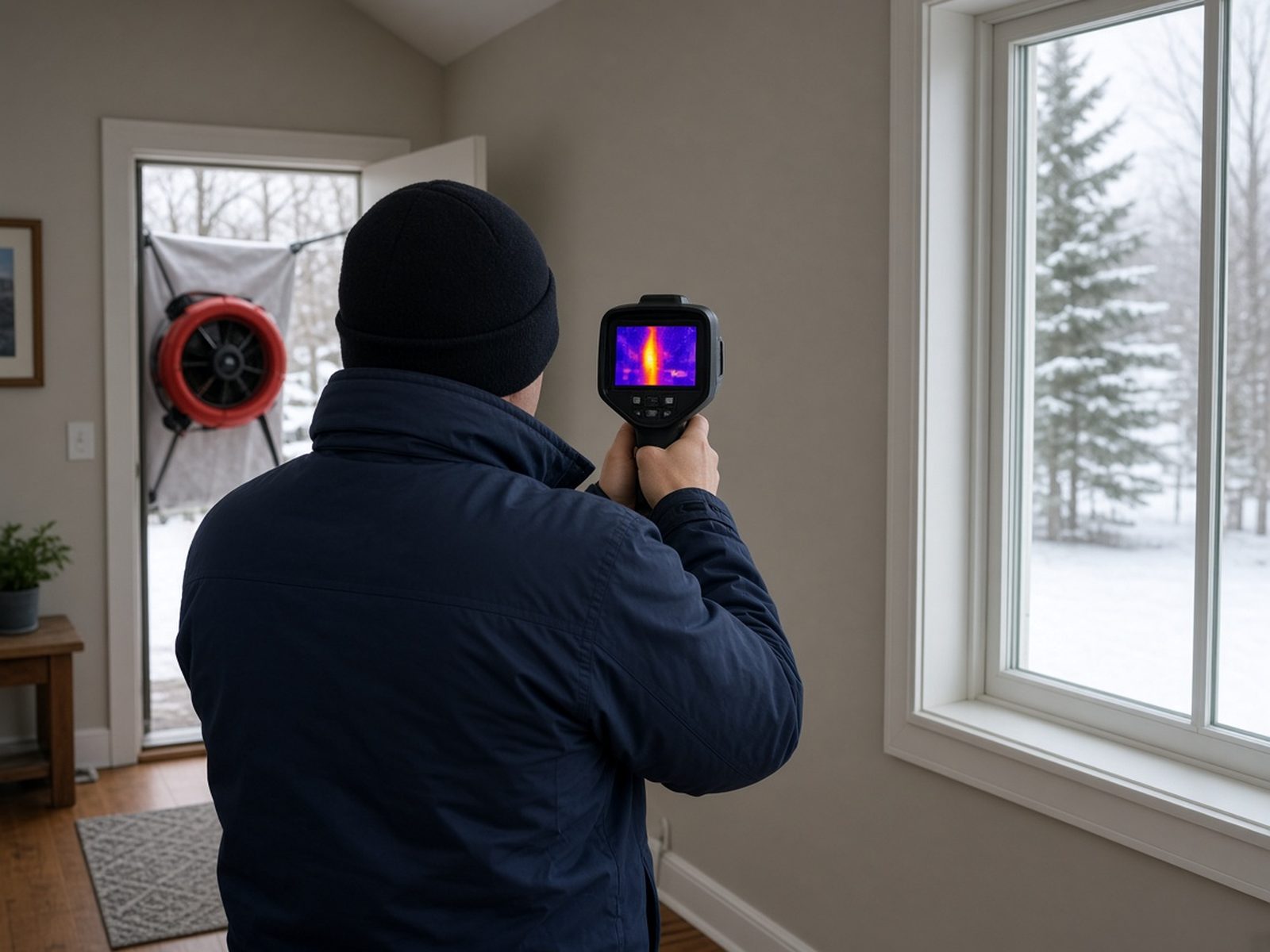
A blower-door depressurization test, a thermal camera scan of every room, a smoke-pencil check of suspect spots and a written list of leaks with photos and priorities. We show you each leak on the camera as we find it. The price is $199 plus HST, and that fee is credited toward your Draft Proofing or Garage & Exposed Floor job if you go ahead with us. [confirm whether minor sealing is included]
How is Draft Proofing priced
By quote. After your Draft Diagnostics visit you get a fixed price for sealing the leaks we found, and you choose what gets done. The $199 Draft Diagnostics fee is credited toward the job if you go ahead with us.
How long does a visit take
Plan on about 90 minutes for Draft Diagnostics in a typical detached or semi-detached home.
How should I prepare for the visit
Please clean all the ashes out of any fireplace or wood stove before we arrive, and make sure the fire has been fully out for at least 24 hours so the ashes are cold. The blower door gently lowers the pressure in the house and can pull ash or soot into the room if anything is left in the hearth. It also helps if exterior windows and doors are closed, we can get to the attic hatch, the basement rim joists and the garage ceiling, and pets are secured in a comfortable spot. Most visits take about 90 minutes, depending on the house.
Is the blower-door test safe
Yes. It's a calibrated fan in a doorway that gently lowers the indoor pressure. We make sure fireplaces and wood stoves are out first so no ash is pulled into the room.
Is this the same as an EnerGuide evaluation
No. This is a hands-on visit to find and fix drafts. If you're applying for a rebate program that requires an official EnerGuide evaluation, ask us and we'll point you in the right direction. [optional: rebate/EnerGuide offer, verify current programs before adding]
Background on why and how to air seal, including the hazards and floor details above, is drawn from Natural Resources Canada's Keeping the Heat In guide. Typical heating and cooling savings figures are from the U.S. Department of Energy's Building America air-sealing guide.